Archive for the 'chocolate' Category

Origin of a Dish: The Ice Cream Cone

Waffle Cone?

I had some custard left over from demoing ice cream making at the Brooklyn Brainery over Labor Day weekend, so I decided to toss it in my ice cream maker and enjoy a little made-from-scratch ice cream at home.  Plus, I wanted to try out these neat tip I learned during class:  I team-taught my session with Soma, one of the founders of the Brainery.  At the end of the class, students could pitch their dream ice cream flavors, and Soma would explain how to make them by using different techniques to incorporate flavors.  To add a “swirl,” like chocolate,  you take the ice cream out of the ice cream maker and you layer it in a Tupperware  much like a parfait:

How to make a chocolate swirl.

Then you put it in the freezer.  When you scoop it, it comes out like a chocolate swirl. I layered my vanilla bean ice cream with U-Bet Chocolate Syrup.

For my class, I did a lot of research on the history of ice cream in America.  I got really curious about the origin of the ice cream cone when I stumbled across this article from Saudi Aramco World: Zalabia and the First Ice Cream Cone.  SAW is a cool publication from which I’ve previously cooked some medieval Middle Eastern recipes.

The idea of an ice cream cone has been around for a few hundred years–they were known as “cornets” in Europe.  But as far as modern American cones, SAW recounts and ice cream cone legend I have heard before:

The Louisiana Purchase Exposition, also called the 1904 World’s Fair, was the largest the US had seen since the 1893 Columbian Exposition in Chicago. It covered some 500 hectares (1235 ac) and showed off such inventions as the year-old airplane, the radio, the telephone switchboard and the silent movie… (There were also less memorable attractions, among them a butter sculpture of President Theodore Roosevelt and a bear made out of prunes.) With more than 18 million visitors passing through the Exposition over its seven-month run, there were also scores of vendors offering much to eat.

(Ernest) Hamwi and his wife, the story goes, took their meager life’s savings and invested them in a zalabia booth, joining other like-minded immigrants from the Levant in attempting to transplant to the US the crisp, round, cookie-like snack so popular back home. Each zalabia was baked between two iron platens about the size of a dinner plate, hinged together and held by a handle over a charcoal fire. They were served sprinkled with sugar. The Hamwis wound up doing their cooking next to one of the approximately 50 ice-cream stands dotted around the fair, though exactly who owned the stand is in some doubt: It was either Arnold Fornachou or Charles Menches. Whoever it was, his ice cream sold faster than Hamwi’s zalabia—so fast, in fact, that one day he ran out of clean glass cups. At this moment, some say, the ice-cream man saw the possibilities of the zalabia; others claim the zalabia man saw the possibilities of the ice cream.

It’s Hamwi himself who originated this story, in an ice cream trade journal, and is generally credited with inventing the ice cream cone.   However, his story has never been proven, nor has there been any evidence found that he had a booth at the fair at all.

But people do seem to think that the 1903 Exposition is the time and place that ice cream and cone met, and that the pizzelle-like zalabia had something to do with it.  I got curious to make a zalabia, which hail from Lebanon, Syria, Greece and Turkey.  However, when a scoured the internet for a recipe, all I could come up with were recipes for north-African zalabia, a yeast-risen, deep-fried dough with honey syrup.  Not the same.

I ended up trying out this Martha Stewart recipe for waffle cones, but being that I don’t have a pizzelle maker, I ended up making waffle cones.  The result was freaking delicious, but not what I had set out to do.

If anyone out there has a zalabia recipe, hit me up! In the meantime, read the rest of the fascinating Saudi Aramco World article here.

Origin of a Dish: Chocolate Chip Cookies

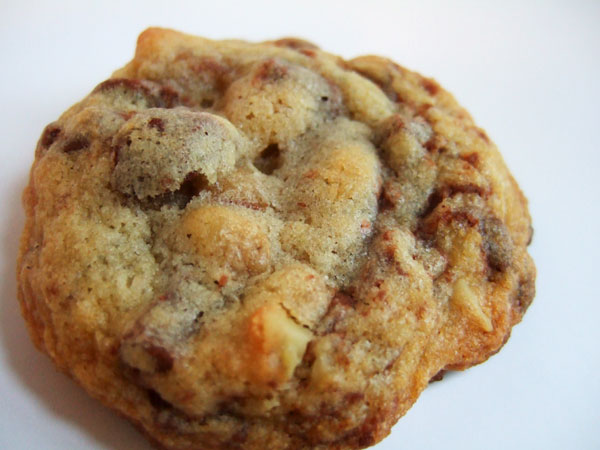
A chocolate chip cookie, baked from the original recipe.

During my recent experiments with chocolate, I got curious about the origins of the ultimate American chocolate dessert:  The Chocolate Chip Cookie.  Keep reading for the original recipe, which, in my opinion, is the perfect cookie.

Ruth Wakefield  is credited for the invention of the chocolate chip cookie at her Toll House Restaurant Whitman, Mass., “…a very popular restaurant that featured home cooking in the 1930s. The restaurant’s popularity was not just due to its home-cooked style meals; her policy was to give diners a whole extra helping of their entrées to take home with them and a serving of her homemade cookies for dessert.” (wikipedia)

The legend of the cookie’s creation goes like this: “Wakefield is said to have been making chocolate cookies and on running out of regular baker’s chocolate, substituted broken pieces of semi-sweet chocolate from Nestlé thinking that it would melt and mix into the batter. (wikipedia)”  I don’t believe this explanation.  Baker’s chocolate doesn’t magically melt into cookie dough, so if Wakefield knew how to work with baker’s chocolate, she would know that a semi-sweet Nestle bar would behave the same way. The legend makes her seem like a foolish little lady that made a silly mistake that magically turned into something wonderful.  I think she was actually an extremely talented cook with a brilliant idea.

Whatever the truth is, she sold her idea to Nestlé in exchange for a lifetime supply of chocolate (or so the story goes; I think she was probablly a smarter business woman than that).  Wakefield’s cookie recipe was subsequently printed on the back of all Nestle’s chocolate bars.  At first, Nestle included “a small chopping tool with the chocolate bars, but in 1939 they started selling the chocolate in chip (or morsel) form.” (wikipedia).

Chocolate chip cookies are The Official Cookie of the Commonwealth in Massachusetts: http://www.malegislature.gov/Laws/GeneralLaws/PartI/TitleI/Chapter2/Section42

Wakefield released a cookbook in 1936, Toll House Tried and True Recipes, which features the original chocolate chip cookie recipe as “Toll House Chocolate Crunch Cookies.”  The recipe, as well as the rest of the cookbook, can be found online here.  Below, here’s the same recipe from the April 26, 1940 Chicago Tribune (from the food timeline)

Here’s a new cookie that everybody loves because it is so delicious, so different and so easy to make. With each crisp bite you taste a delicious bit of Nestle’s Semi-Sweet Chocolate and a crunch of rich walnut meat. A perfect combination. Here’s a proven recipe that never fails. Try it tomorrow.
1 cup butter
3/4 cup brown sugar
3/4 cup granulated sugar
2 eggs, beaten whole
1 teaspoon soda
1 teaspoon hot water
2 1/4 cups flour
1 teaspoon salt
1 cup chopped nuts
2 Nestle’s Semi-Sweet Economy Bars (7 oz. ea.)
1 teaspoon vanilla
Important: Cut the Nestle’s Semi-Sweet in pieces the size of a pea. Cream butter and add sugars and beaten egg. Dissolve soda in the hot water and mix alternately with the flour sifted with the salt. Lastly add the cholled nuts and the pieces of semisweet chocolate. Flavor with the vanilla and drip half teaspoons on a greased cookie sheet. Bake 10 to 12 minutes in a 375 degree F. oven. Makes 100 cookies. Every one will be surprised and delighted to find that the chocolate does not melt. Insist on Nestle’s Semi-Sweet Chocolate in the yellow Wrap, there is no substitute. This unusual recipe and many others can be found in Mrs. Ruth Wakefield’s Cook Book–”Toll House Tried and True Recipes,” on sale at all book stores.”

A modernized version of this recipe can be found on the Nestle website, here.

The biggest problem in recreating the original recipe is the chocolate; I felt that chopping up a candy bar was an important part of the original process.  But nowadays, Nestle only makes semi-sweet morsels, not bars.  Nestle still makes milk chocolate bars, which I later found at Economy Candy, but for my first attempt at the recipe I had to use a stack of Hershey’s milk chocolate bars.

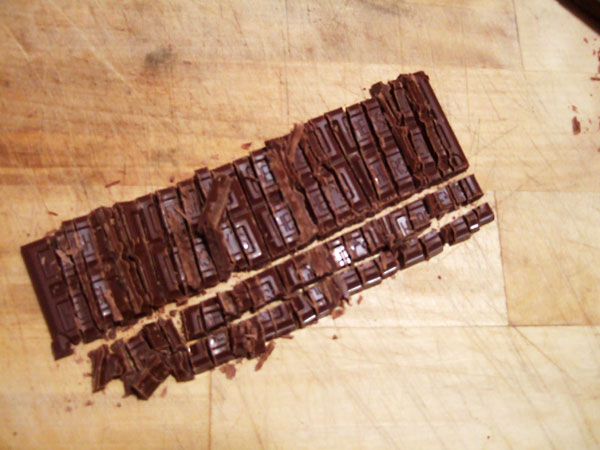
It was much easier to cut up the chocolate bar that I anticipated.  The recipe specified the pieces should be “the size of a pea,” and I tried to remain faithful to that.  I used a large knife and the job was done in short order and with little effort.  The chopped chocolate smelled seductive and got me thinking: why are we restricting ourselves to the bags of chocolate chips in the baking aisle, when there is a bevvy of delicious, interesting chocolate bars available?  Hachez, a German company, makes dark chocolate bars infused with orange, blackberry, mango/chili, and strawberry/pepper.  Mast Brothers Chocolate, in Brooklyn, features a variety of carefully crafted dark chocolate bars of single origin cocoa beans, as well as bars sprinkled with sea salt and ground coffee.  Put that in your cookie dough and bake it.

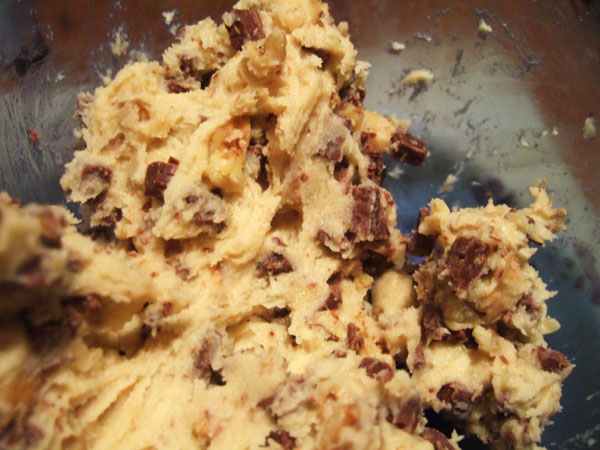
The dough mixed quickly and easily; it was baked and in my mouth in less than an hour.  The first bite of warm, melty cookie made me think of s’mores and brought back a flood of childhood memories.  The cookies were agreed to be perfect by all that sampled them: the best ratio of chocolate to nuts to everything in between.  Everyone was shocked to learn it was the first chocolate chip cookie recipe and wondered why it was ever changed.

For more on chocolate cookies, check out this recipe for one of the first known uses of chocolate in baking.

Chocolate Delight: Tunnel of Fudge Cake

Tunnel of Fudge cake bakes up tall, with a glossy, brownie-like crust.  Break pieces off and eat it; no one will know.

I’m wrapping up Chocolate Delight week with a bang: a cake that has a built-in Tunnel of Fudge.

The legend of this cake was related to me by Jessica, the author of Pictures of Cake.  This cake won second place at the 1966 Pillsbury Bake-off, losing to ‘”golden gate snack bread,”‘  a yeast bread made with instant flour, processed cheese spread, dry onion soup mix and butter.(source)”  Blech.  The snack bread has been long forgotten, while Tunnels of Fudge lives on.

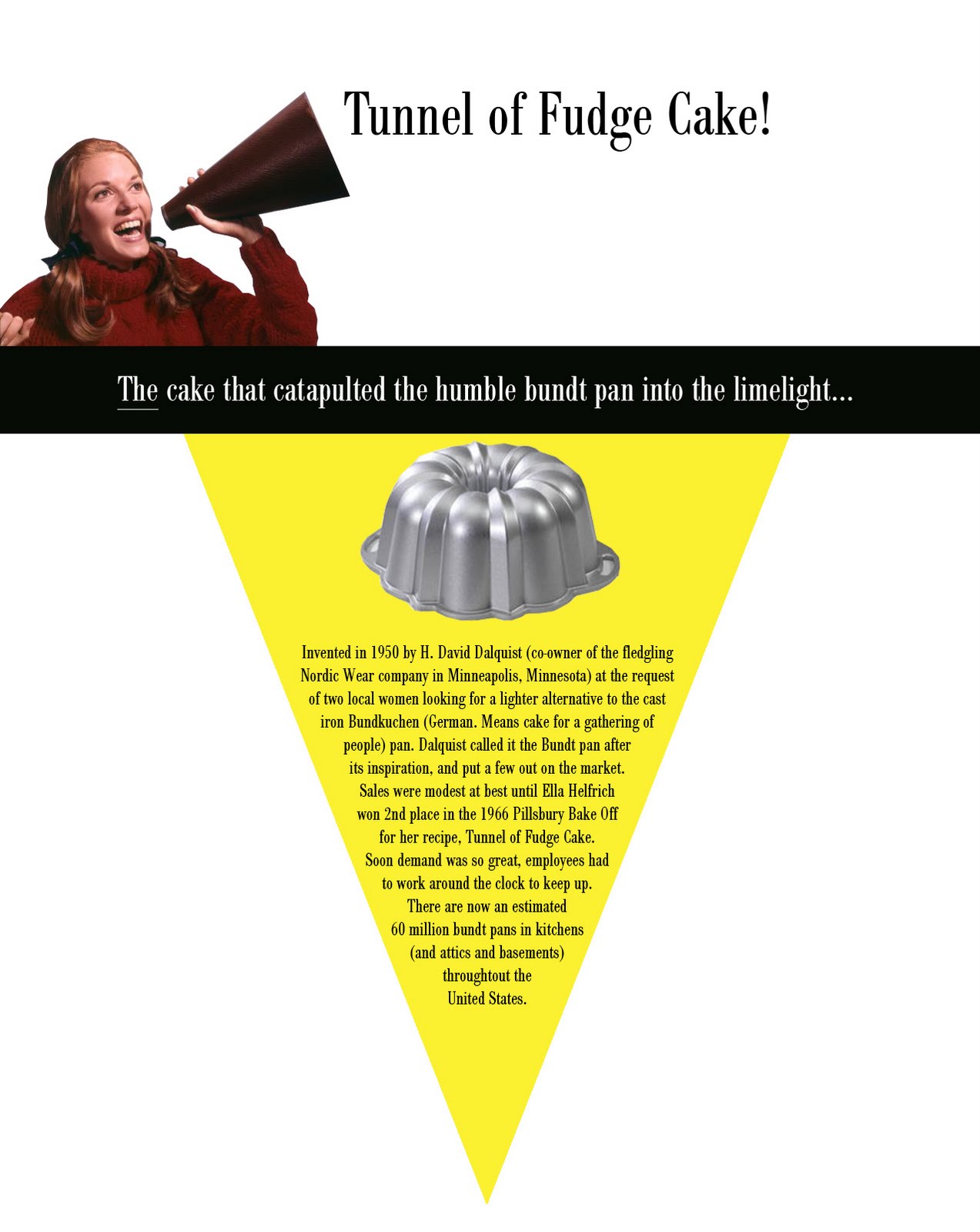
The Tunnel of Fudge cake was a technical revolution: first, it produced a moist cake with a fudgy, uncooked center, perhaps the ancestor of the modern Molten Chocolate Cake.  Second, it used a Bundt pan.  For a little more information on that, take a look at Jessica’s invitation to her ToF Cake party:

Third, this cake is quite possible the least healthy thing I have ever made.  It contains approximately 60 eggs, 1 millions pounds of butter, and 20 cups of sugar.  Originally, it was made with a pre-packaged, powdered frosting mix called Double Dutch Fudge Buttercream.  Here are the original recipe and image from the 1966 Pillsbury Bake-Off Cookbook:

Tunnel of Fudge Cake
1 1/2 cups soft Land O’ Lakes Butter
6 eggs
1 1/2 cups sugar
2 cups Pillsbury’s Best Flour (Regular, Instant Blending or Self Rising*)
1 package Pillsbury Double Dutch Fudge Buttercream Frosting Mix
2 cups chopped Diamond Walnuts

Oven 350° [ed. 350 F / 175 C]
10-inch tube cake

Cream butter in large mixer bowl at high speed of mixer. Add eggs, one at a time, beating well after each. Gradually add sugar, continue creaming at high speed until light and fluffy. By hand, stir in flour, frosting mix, and walnuts until well blended. Pour batter into greased Bundt pan or 10-inch Angel Food tube pan. Bake at 350° for 60 to 65 minutes. Cool 2 hours, remove from pan. Cool completely before serving.

Note: Walnuts, Double Dutch Fudge Frosting Mix and butter are key to the success of this unusual recipe. Since cake has a soft fudgy interior, test for doneness after 60 minutes by observing dry, shiny brownie-type crust.

***

After the frosting mix was discontinued, Pillsbury developed a modern recipe which you can find here. This is the recipe I baked from, with a few minor changes that I will include below.

***
Tunnel of Fudge Cake, REMIXXXX

Adapted from Pillsbury.com and
The 17th Annual Pillsbury Busy Lady Bake-Off Cookbook, 1966

2 3/4 cups granulated sugar
1 3/4 cups  (2 and 3/4 sticks) butter, at room temperature
6 eggs
2 1/4 cups flour
3/4 cup unsweetened cocoa
1/4 tsp salt
2 cups chopped walnuts (the recipe notes that “Nuts are essential for the success of this recipe.” ha!)

1. Grease a bundt pan and dust with additional cocoa powder.  Preheat oven to 350 degrees.

2. In a large bowl, whisk together flour, cocoa powder, and salt.  Set aside.

3. Cream together sugar and butter until light and fluffy, about three minutes at medium speed.  Add eggs one at a time, mixing thoroughly after each one.

4. With mixer on low, slowly add dry ingredients.  Scrape bowl, then mix until combined.

5. With a spatula, fold in walnuts.  Spoon batter into bundt pan; bake 45 minutes or until top has a dry, shiny brownie-type crust.  Cool upright in pan on wire rack 1 1/2 hours. Invert onto serving plate; cool at least 2 hours.

***

Can someone please tell me how to get a cake out of a bundt pan?  Mine always comes out in broken, shameful pieces.

When I cut my cake, it wasn’t puking out fudge like in the 1966 photo; but, running down the middle was a dense spine of goopy fudgeness.  My oven tends to run a little hot, so I think the cake was slightly over-baked: ten minutes less would have allowed a much thicker fudge vein.

The cake was good; the walnuts were a nice break from what would have been a total chocolate assault.  But the cake also had a greasy mouth-feel thanks to the million pounds of butter.  And it’s sooooo swweeeeeet.  I even made it with a cup less sugar than the Pillsbury recipe calls for.

I don’t know.  I’d be curious to have more people give this bizarre chocolate cake a whirl and tell me what you think of the final results.

Chocolate Delight: Chocolate Wafers

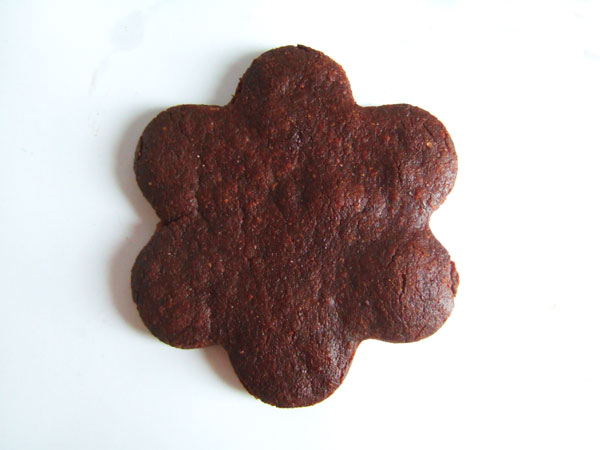
Chocolate Wafer cookies; from Gourmet, February 1950.

Faced with the task of consuming chocolate, I decided to reference a book that I had gotten for Christmas: The Gourmet Cookie Book: The Single Best Recipe From Each Year 1941- 2009. It’s a cool anthology that reflects the changing tastes of the last 70 years.  I wanted a rich, chocolately cookie, and I found this recipe for Chocolate Wafers from Valentine’s Day, 1950:

“Chocolate Wafers: Good cooks were pleasing their menfolks with chocolate cakes back during the early settling of the New England colonies…Modern ways are upon us, atom bombs bedevil our dreams, standardization of taste haunts our mealtimes–but chocolate is still chocolate.”

Intense!  But also inaccurate–chocolate cake recipes didn’t start appearing until the later half of the 19th century.  Just FYI.

***
Chocolate Wafers

From Gourmet magazine, Feb 1950
As Reprinted in  The Gourmet Cookie Book: The Single Best Recipe From Each Year 1941- 2009

3/4 cup Butter, room temperature
1 1/4 cups Sugar
1 tb Rum Extract (I didn’t have any, I used rum)
1 Large Egg
1 1/2 cups Flour
3/4 cup Unsweetened Cocoa Powder
1 1/2 tsp Baking Powder
1/4 tsp Salt

1. Sift together flour, cocoa, baking powder and salt. Set aside.

2. Cream butter.  Add sugar gradually and cream together until light and fluffy.

3. Add egg and rum. Beat thoroughly

4. With mixer on low, gradually add dry ingredients, mixing thoroughly after each addition.

5. When completely mixed, refrigerate overnight.

6. Roll out dough 1/8th of an inch thick; cut into fun shapes; bake in a 375 degree oven for 6-8 minutes.

***

This recipes mixes up very quickly, but the dough is hellish to work with.  It was somehow both dry and crumbly and extremely sticky.  It did allow me to use some of my vintage cookie cutters as well as a vulgar cutter my roommate gave me for Christmas.

The cookies are tasty.  I liked the texture best when they first came out of the oven: they were really crispy and flaky.  They got a little more dense as they cooled, but still very good.  If I was going to make an artisanal Oreo, I would use this recipe.

These cookies are getting shipped off to Washington DC for a friend’s very belated birthday present.  Not the vulgar ones, though.  The balls got a little burned.

Chocolate Delight: Royal Hot Chocolate

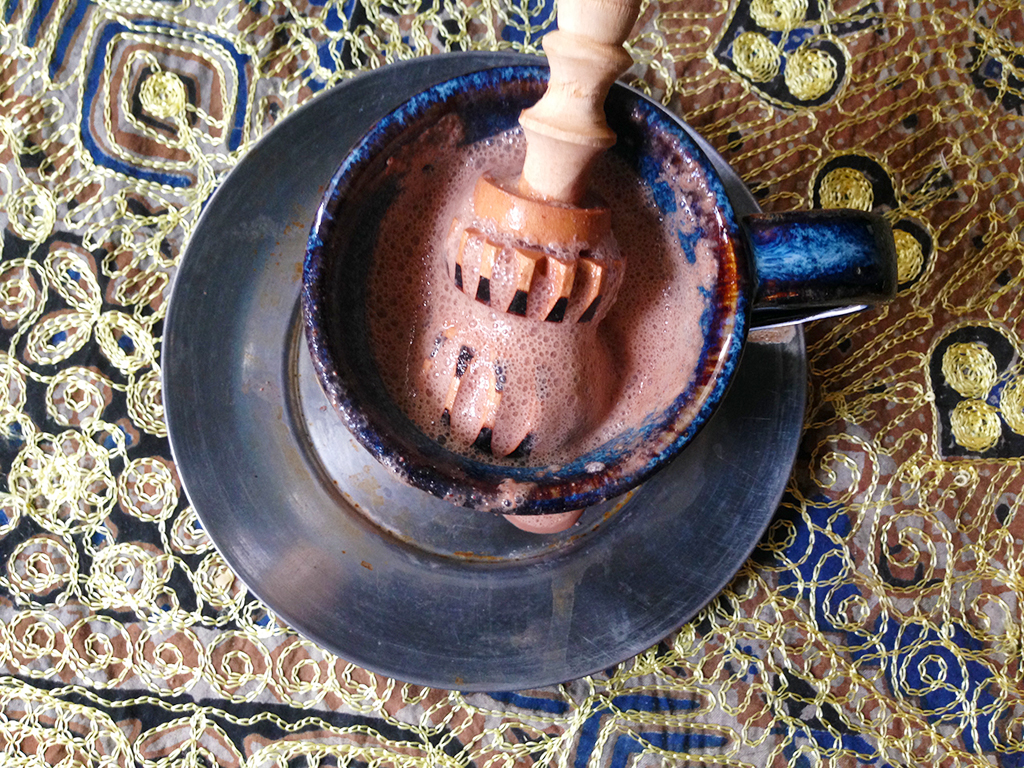
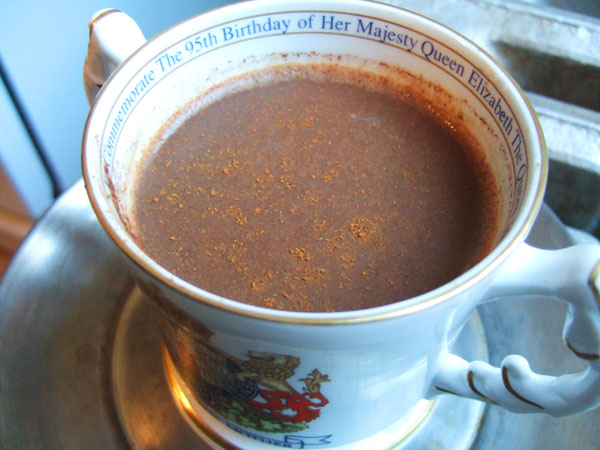
Royal Chocolate in a royal cup.

It’s cold in New York.  Reaul cold.  At the end of a long day, I needed a little pick me up.  So I cracked a cookbook my Aunt had given me for my birthday, a 1971 reprint of a 1934 Hershey’s Cookbook.

The book has been “adapted to a modern kitchen,” so that could mean anything in terms of reinterpretations of the original recipes.  But regardles, I do enjoy cooking up some 70s kitsch.

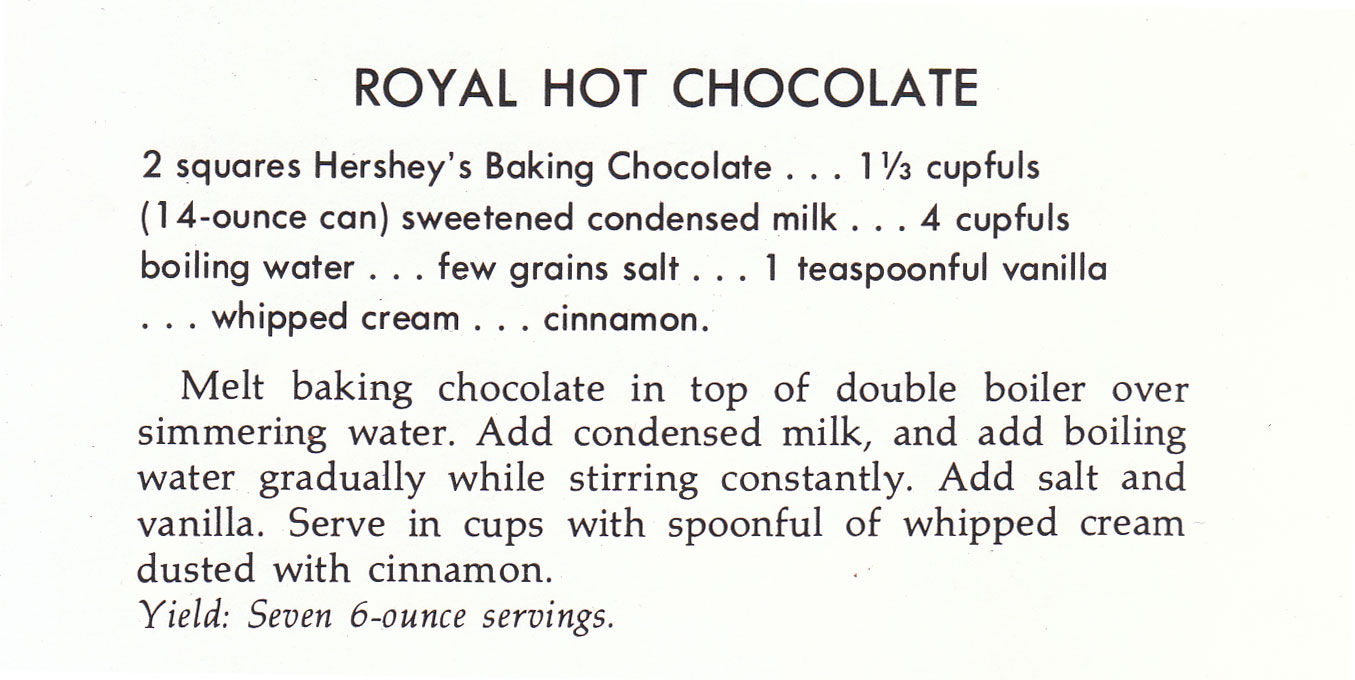
In the “Beverages” section, I came across this recipe for Royal Hot Chocolate.

Sounds so decadant!

***
Royal Hot Chocolate

From the 1934 Hershey’s Cookbook (1971 expanded and updated edition)

2 squares Unsweetned baking chocolate
1 14 ounce can sweetned condensed milk
4 cups boiling water
Pinch salt
1 tsp vanilla
Whipped cream and cinnamon (optional)

1. Melt baking chocolate in a double boiler: a glass bowl set over a saucepan of boiling water will do just fine.

2. Add condensed milk, then GRADUALLY add boiling water while whisking vigorously.  Heed this advice; I didn’t, and dumped the water in.  Despite some vigorous whisking, I ended up with grainy hot chocolate.  And the water must be BOILING, or else you’ll end up with a lump of unmelted chocolate and water.

3. Add salt and vanilla, and serve, with whipped cream and a dusting of cinnamon if desired.

***

Since it is Royal Hot Chocolate, I served it up in the royalest mug I had: A double-handled cup commemorating the Queen Mum’s 95th birthday.  When I first sipped the chocolate, I wasn’t bowled over.  But the more I drank, the more I realized how smooth it was.  How chocolately.  And not too sweet.  It was perfect in every way.  In a feat of decadence, I drank this hot chocolate while taking a hot shower.  I feel Awesome.

Chocolate Delight: Mahogany Cake

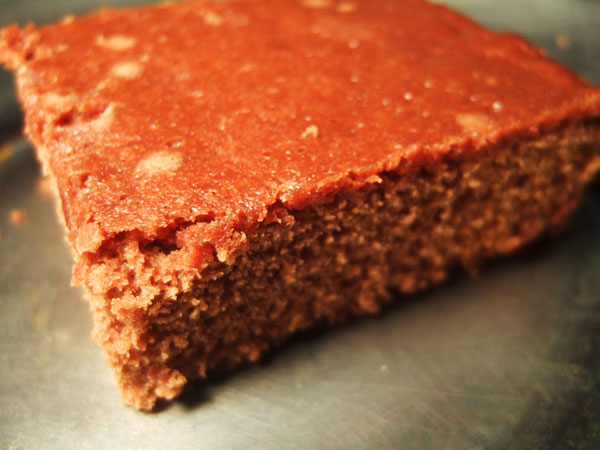
Mahogany Cake: cocoa powder and brown sugar.

Have you ever read A Cake Bakes in Brooklyn?  You should.  Some months ago, the author loaned me a book by a mysterious cake maven named Mrs. Osborne.  Read more about this fascinating woman, with a unique perspective on how to bake a cake, here.

I’ve baked one recipe from Mrs. Osborne’s book, a fairly unsuccessful Puff Cake.  But another recipe captured my attention, a brown sugar and chocolate confection called Mahogany Cake.

***
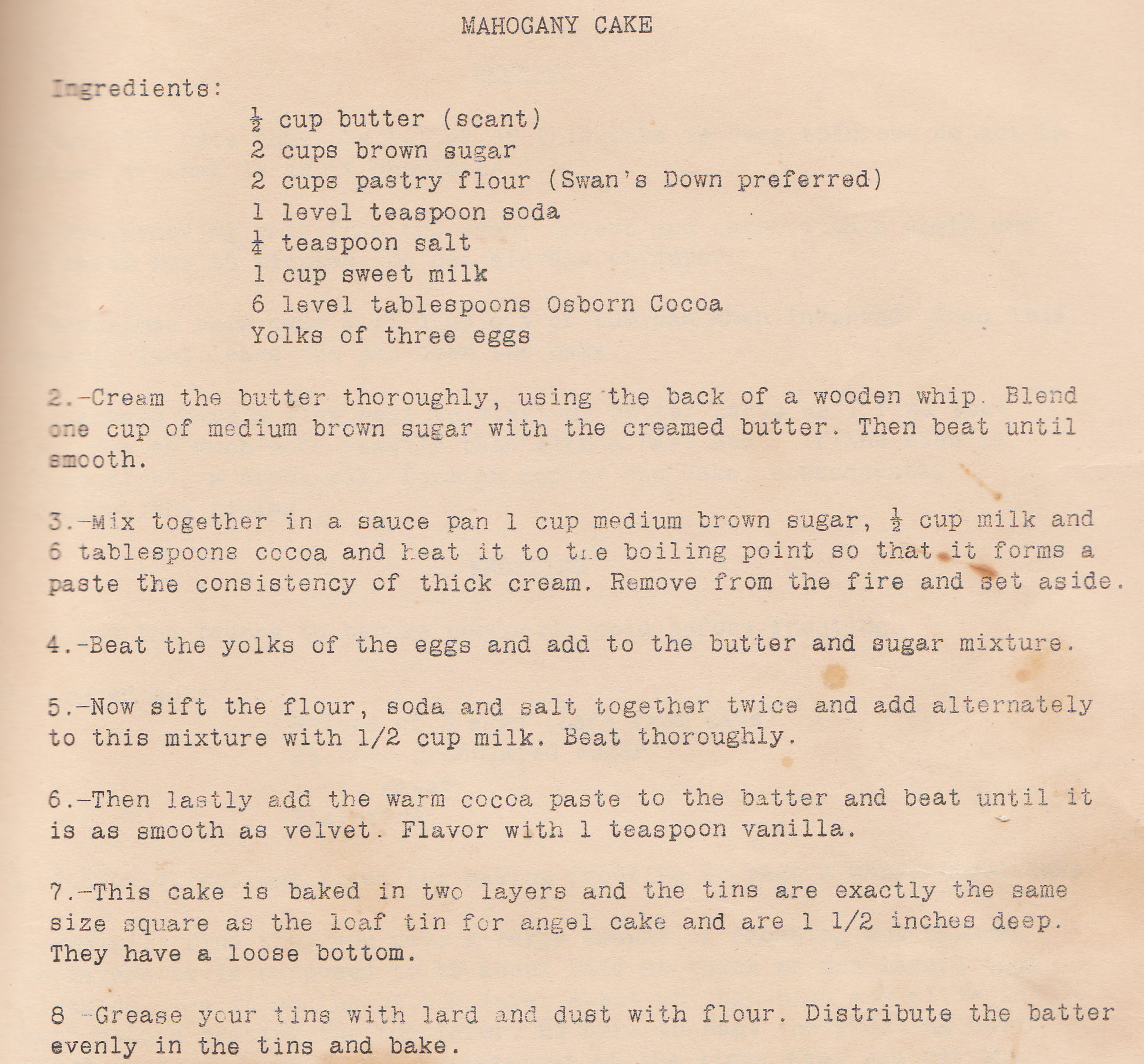
Mahogany Cake
From Mrs. Osborne’s Cakes of Quality, by Mrs. Grace Osborne, 1919.

I didn’t have the pans she wanted, so I baked it in a regular rectangular cake pan, which I buttered and dusted with cocoa powder.  The milk, sugar and cocoa powder comes to a quick boil, so watch out for that.  After I mixed the flour in, the batter was super smooth; when the melted chocolate was added, it was very velvety, just like Mrs. Osborne promised.  Don’t forget the teaspoon of vanilla at the end; she doesn’t list it in the ingredients.

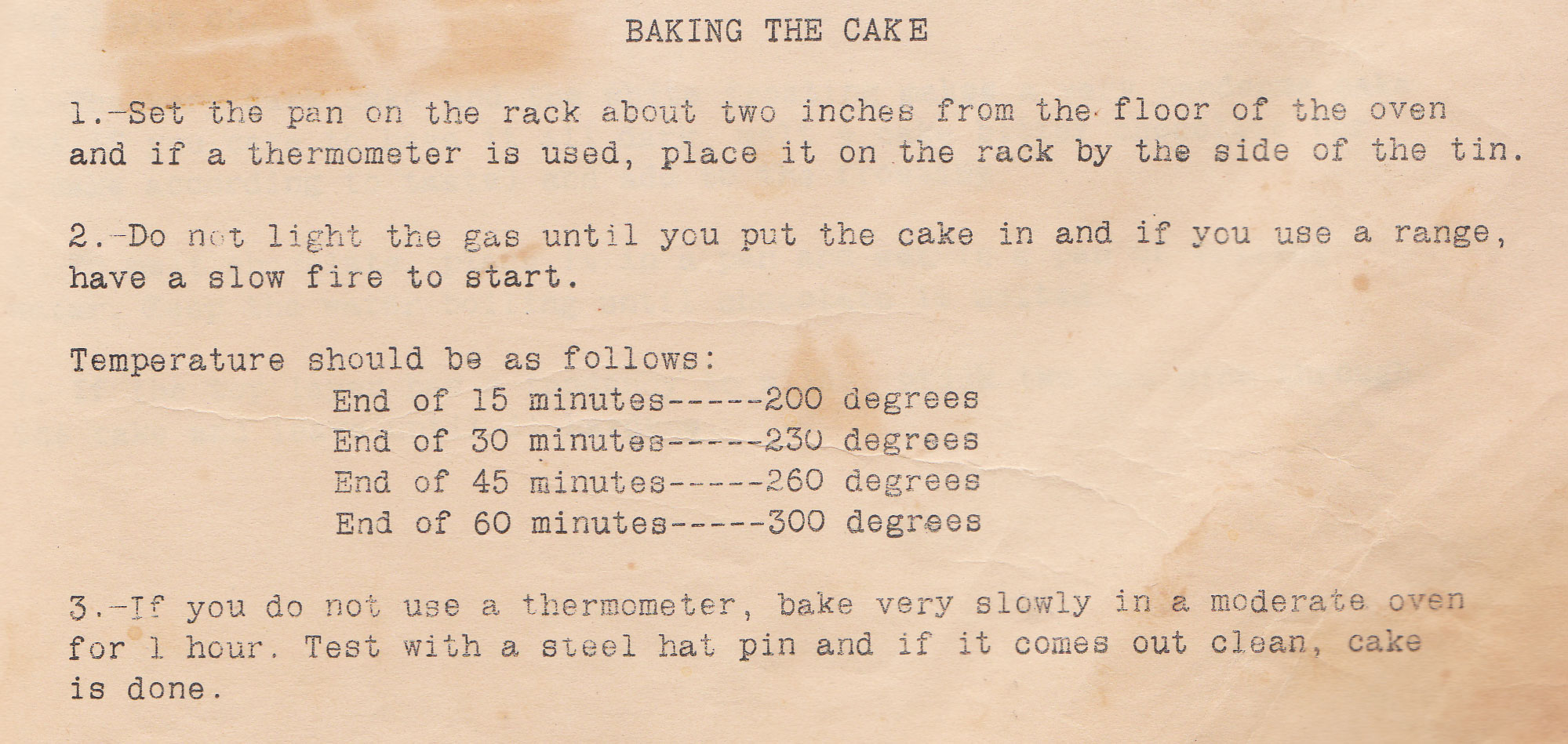
When completed, the batter tasted like hot fudge.  The cake showed promise.  But here comes round two, Baking the Cake.  Pay careful attention, it is detailed:

I ALWAYS managed to fuck this part up, because I forget to reset the timer.  That’s how the Puff Cake got overcooked and tough last time; this time I forgot to set the timer after 230 degrees.  So I went from 230 to 300 in the last 15 minutes. Grr.

The  results: the cake had a nice fudgy flavor.  I actually do not like chocolate cake (Short story: my mother was a prize baker, once she was testing a million chocolate cake recipes, I ate too much cake and puked.  Haven’t been able to stomach it since.)  but the flavor was rich enough I didn’t find it off putting.  But the texture was not great: although the top was most, the center and bottom of the cake was really dry and unpleasant.  That’s the same problem I had when I made the puff cake.

Mrs. Osborne’s ridiculous baking methods seem like they’ll be worth the trouble; they stink of some long forgotten baking secret.  But in reality, the long, low bake time seems to dry the cakes out.  Thumbs down, Mrs. O.

Retronovated Recipes: Chocolet Puffs


A few weekends ago, I was awarded Best in Show at the Havemeyer Sugar Sweets Festival, a fundraiser for the City Reliquary. I was especially proud of my prize because the recipe that won, Chocolate Puffs, is one of my favorite creations.

I first came across the recipe for Chocolate Puffs in The American History Cookbook, an excellent resource by Mark H. Zanger that uses food to teach cultural history. That’s right up my alley.

The recipe, which is from a 1750s manuscript, is fascinating because it is “one of the first recipes in English for any use of chocolate other than drinking.”

Take a pound of Loaf Sugar, beat and Sifted very fine, 2 Ounce of Almonds blancht and beat very fine with a little Orange Flower water or any other, to keep them from Oyling, but not to make the same too thin, take 2 ounces of Chocolet and grate it, then mix it well together, the take the wfite of an Egg and beat it to a froth, if one be not Enough take a little more, then beat it well to a paste & Squert it, and do it on Slight paper and Set the same in an oven after Bread, of Chocolett Ditt it up a while but not for White ones, for fear of making them brown.

I realized this recipe was the perfect vehicle to try out the block of American Heritage baking chocolateI had picked up on my recent trip to Washington DC. American Heritage is chocolate produced by the Historic Division of Mars, Inc.

“The Historic Division of Mars was established in 2006, with the vision of becoming the undisputed leader in chocolate history. Our mission is to relentlessly pursue and share chocolate’s rich past, by creating authentically historic chocolate experiences that allow our consumers to enjoy the fusion of chocolate history and Mars Chocolate excellence.

It’s “Handcrafted chocolate made from an authentic colonial recipe…available during the 17th century.” I’m a huge nerd, so when I discovered that there was an authentic historic chocolate being produced, I was beside myself with excitement.

Early chocolate was produced sweetened cakes and sold as a spice. Until the later half of the 19th century, it was primary served as what we know of as hot chocolate. My block of American Heritage chocolate is about 5 oz of pressed cocoa, delicately spiced with anise, red pepper, nutmeg, orange and cinnamon. It seemed only fitting to feature the unique taste of this chunk of chocolate history in my recipe for Chocolet Puffs.

If I’m reading the Chocolet Puffs recipe correctly, it gives you an option of melting the chocolate before adding it to the whipped egg whites, but primarily advises you to simply grate it and stir it in to the meringue, much like you would use a spice. I searched for a comparable modern recipe to use as a jumping point for my baking process: I came across a wonderful recipe for Chocolate Meringues in Martha Stewart’s Cookies that stirred shaved chocolate into a Swiss meringue; a concept incredibly similar to my 18th century recipe.

***
Chocolate Puffs (1750s)
From a manuscript housed at Tyron Place, as published in the American History Cookbook.

Modern recipe inspired by “Chocolate Meringues” from
Martha Stewart’s Cookie Book.
4 large eggs whites
1 cup sugar
Pinch of cream of tartar
Pinch of Salt
1/2 tablespoon Orange Flower Water*
1/4 cup grated American Heritage chocolate

1. Preheat oven to 175 degrees. Combine egg whites, sugar, cream of tartar, salt and orange flower water in a heat proof bowl of an electric mixer. Set in a double boiler. Cook on a low heat, whisking constantly, until the sugar has dissolved and the mixture is warm to the touch.

2. Transfer bowl to electric mixer fitted with a whisk attachment; beat starting on low speed and gradually increasing to high, until stiff, glossy peaks form, about 10 minutes.
3. Gently fold in chocolate, taking care not to crush the meringue.

4. Transfer meringue to a pastry bag, or (like I did) a Ziploc bag with one corner cut off. Pipe quarter sized, “kiss” shaped cookies onto a non-stick cookie sheet, or parchment lined cookie sheet.

5. Bake cookies for two hours.

*Orange Flower Water can be found in Middle Eastern grocery stores; I live in an ethic neighborhood, so my local grocery store carries it, along with three different brands of Rose Water. It is a historic gastronomist’s paradise.

***

And that’s all there is to it. The process is time consuming, but simple. The results: a depth and intensity of flavor I would not have thought possible from these crispy, sweet little puffs.

Travelogue: Mt. Vernon

The Whiskey Distillery at Mt Vernon.

On day two of my travels in our nation’s capitol, I piled in the car with my friends Bryan and Katie, and made the drive to George Washington’s home, Mt. Vernon.
It was a spectacularly beautiful fall day, and there was no where I would have rather been that driving along the Potomac with the windows down. The three of us lunched at the Mt. Vernon Inn, which offers “…six intimate dining rooms, two with fireplaces, all with colonial charm, colonial servers, and delicious regional and colonial cuisine.”

I had the “Colonial Turkey Pye,” (the “y” makes it old timey) which was ok, but unimpressive. I think the vegetables were from a frozen bag mix, and it had a giant Ritz cracker hat. Bryan had a cup of peanut soup, which I had tried before at the cafeteria at Gettysburg. I had liked it at Gettysburg, but here it tasted like warm peanut butter. Gross.
The main disappointment was that the menu had foods that could have been eaten in the 18th century, like roasted chicken and corncakes, but the foods weren’t at all different from what we eat today. There wasn’t even an effort to use spices appropriate to the 18th century. It’s dull; I never understood why “historic” restaurants never make the effort to offer interesting, delicious historic food.
We spent a few hours touring the grounds, and took a fairly boring tour of the Mansion itself. The house sees a high volume of visitors each year, and the staff handles this by scooting a continuous line of tourists along a velvet-roped route through the interior of the building, while reciting the interpretation for each space on a continuous loop. You would enter the room at the beginning of the interp, and leave approximately when it would start repeating. It was weird. One fact did catch my attention: Washington died suddenly of an inflammation of the throat, that suffocated him in 36 hours. I got a little freaked out when I felt a cold coming on a few days later.
Next, we went to Mt. Vernon’s second site which features a reconstruction of Washington’s Gristmill and Distillery. I had been looking forward to visiting the recently opened distillery for awhile, and it really was a treat. A knowledgeable interpreter talking us through the distilling process while we toured a truly beautiful building. I learned that in the 18th century, whiskey was made from rye, with a little corn. It was not aged; the entire distilling process took only two weeks before it was casked and sold. The liquor was clear, and our guide described it as tasting surprisingly sweet. Mt. Vernon will begin selling its whiskey sometime in the next year, and I am excited to try it when they do.
The gristmill was also neat, as gristmills are. Every time I stand before a spinning water wheel, and all those gears and grindstones, I’m impressed by human ingenuity. Who thinks of these things??

Looking down from the second floor of the gristmill, to the stream below.
I picked up a little souvenir treat for myself: a 5-ounce block of American Heritage Chocolate, a product of the Historic Division of Mars, that is made from an authentic Colonial recipe. I’m going to use it to make “Chocolet Puffs,” a receipt from a 18th century manuscript that is one of the earliest instances of chocolate being used in another manner than for drinking. If the recipe turns out well, they will be sold at The City Reliquary’s 1st Annual Haveymeyer Sugar Sweets Festival on Saturday. But more on that tomorrow.
See more images from my trip below.